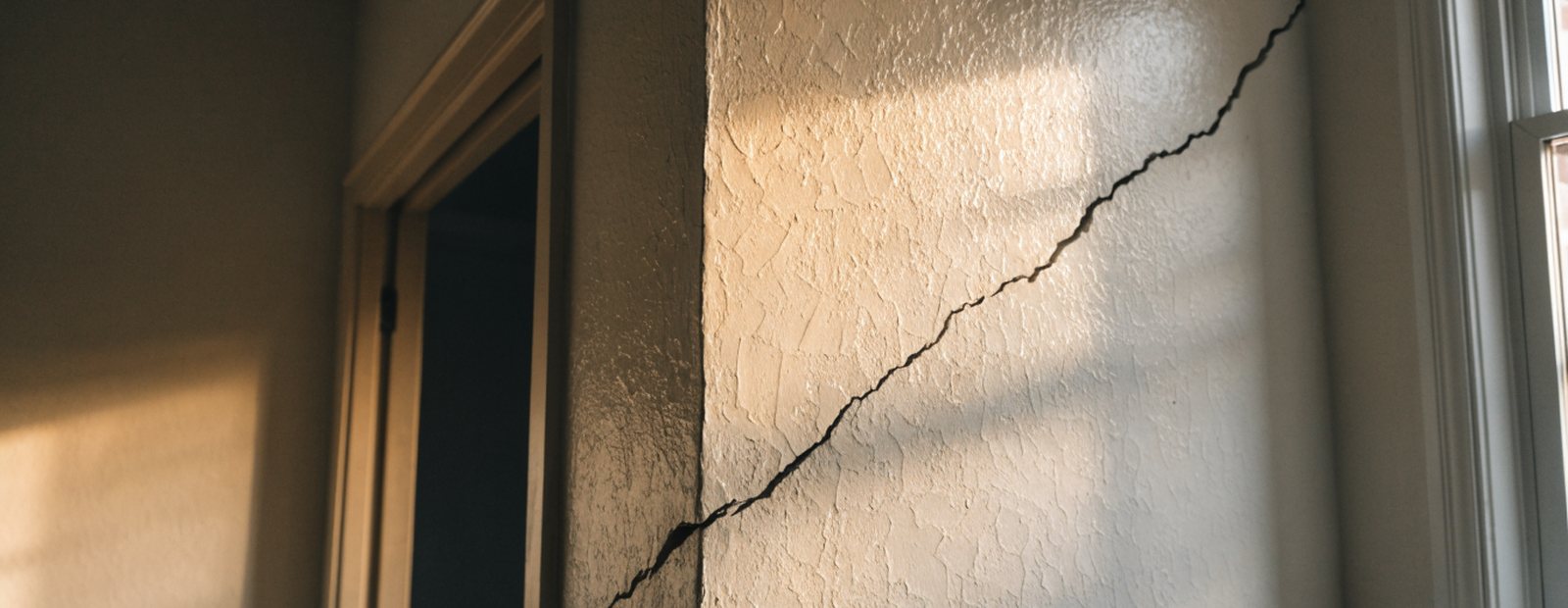
If your home in Meridian, Nampa, Caldwell, or Kuna was built before 2000, sooner or later you're going to notice cracks in the drywall — usually in the same places. Above doorways. Up the corners of vaulted ceilings. Along the seam where the ceiling meets the wall. Most of them are normal. A few of them aren't. Knowing which is which keeps you from either ignoring something serious or spending money on something cosmetic.
Why Treasure Valley Drywall Cracks So Predictably
Three things conspire here:
- Idaho's expansive clay soils. Much of Meridian, Nampa, and parts of Caldwell sit on clay that swells when wet and shrinks when dry. Homes ride that motion subtly, year after year.
- The dry winter air. Boise winters routinely drop indoor humidity below 20%. Wood framing shrinks. Drywall tape pulls. Joints crack.
- 1970s and 80s construction shortcuts. A lot of subdivision homes from that era used thin mud passes, shorter nails, and less tape than modern builds. The original work was fine — until 40 years of seasonal movement.
The Five Most Common Drywall Issues — and What They Mean
1. Hairline cracks above doors and windows
By far the most common. These cracks run diagonally from the upper corners of door and window frames. They're almost always cosmetic — the result of normal seasonal expansion at the structural weak point in the wall (the header above the opening).
Fix: Open the crack slightly with a utility knife, fill with a flexible patching compound (not regular spackle — it'll crack again next winter), let dry, sand, and repaint. Use a mesh patch for cracks over a quarter-inch wide.
2. Long ceiling-to-wall seam cracks
Often visible only when the sun hits at the right angle. These are caused by "truss uplift" — the roof trusses flexing up and down with humidity changes. The wall stays put. The ceiling moves. Tape pops.
Fix: The right repair is to re-tape the joint with a crown molding or a flexible corner bead designed for truss movement. Just re-mudding will fail again. This one is worth hiring out unless you've taped drywall before.
3. Nail and screw pops
Tiny circular bulges or popped paint where a fastener has worked its way out of the framing. Very common in homes 25+ years old.
Fix: Drive a new drywall screw into the stud about 1.5 inches above the popped nail. Then set the popped nail or screw back below the surface with a nail set or screwdriver. Mud, sand, paint. Easy.
4. Stair-step cracks
Cracks that climb diagonally across multiple drywall panels, sometimes in a stair-step pattern. Sometimes through walls and ceilings on the same line. These are a yellow flag — they often indicate active foundation movement, not just settling.
Fix: Don't just patch and paint. Get a foundation assessment first. Most Valley homes that show this pattern need a structural evaluation. Patching drywall over an active foundation issue is throwing money at the symptom.
5. Brown or yellow stains
Discoloration on drywall, especially on ceilings or near exterior walls. These are almost always water-related — and water is the one thing you don't want lingering inside a wall in the Valley's climate.
Fix: Find the leak source first. Roof leak? Plumbing leak? Ice damming in winter? Sprinkler overspray? Don't repaint until you've solved the underlying problem and the area has fully dried. A stain-blocking primer (Kilz or equivalent) before topcoat keeps the discoloration from bleeding through.
The "should I worry?" test
A crack you can put a quarter into is structural until proven otherwise. A crack you can barely fit a credit card into is almost always cosmetic. Cracks that get noticeably wider over a few months — regardless of size — should be evaluated.
What About Plaster Walls?
Some older Boise homes (especially in the North End and Bench neighborhoods built before 1960) have plaster, not drywall. The cracks look similar but the repair is different — plaster needs to be re-keyed where it's separated from the lath behind it. Don't use drywall patching techniques on plaster; the patch will fail.
When to Just Patch and Move On
Honestly, for cosmetic cracks, just patch them and move on with your life. The dry-winter, swelling-summer cycle means you'll be patching the same kinds of cracks every 5–7 years no matter what — that's just life in the Valley.
What's worth doing once and doing right is texture matching. Treasure Valley homes have wildly inconsistent textures — orange peel, knockdown, skip-trowel, smooth. A bad texture patch is more noticeable than the original crack. We do drywall repair and texture matching regularly and it's a faster job to hire out than most homeowners expect.